
HGH
Human Growth Hormone (HGH): Biochemical Mechanisms, Therapeutic Applications, and Clinical Efficacy
Human Growth Hormone (HGH) is a peptide hormone critical for growth, metabolism, and tissue repair, with clinical applications in endocrinology and regenerative medicine.
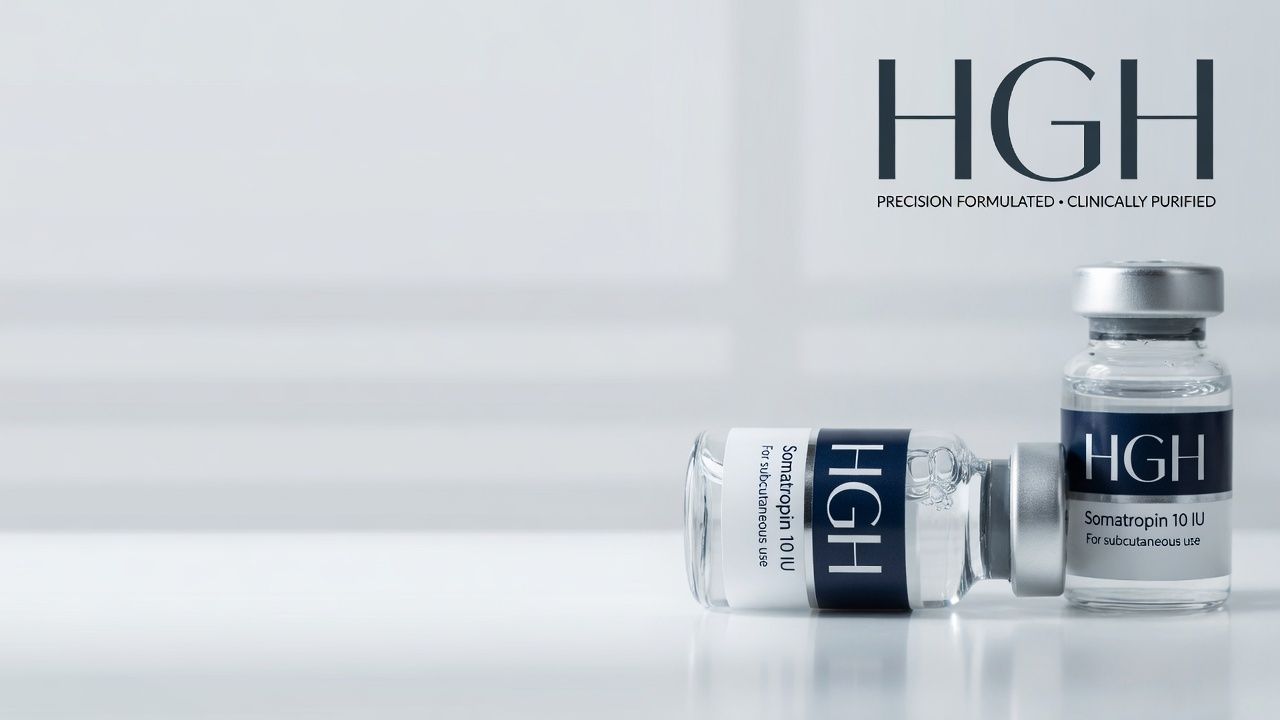
Human Growth Hormone (HGH), a 191-amino acid peptide secreted by the anterior pituitary gland, functions as a central regulator of growth, metabolism, and cellular regeneration. Its primary role involves stimulating linear growth in children, maintaining tissue homeostasis in adults, and modulating lipid and carbohydrate metabolism. Clinically, HGH is prescribed for growth hormone deficiency (GHD), Turner syndrome, Prader-Willi syndrome, and muscle-wasting conditions. The hormone exerts its effects via binding to growth hormone receptors (GHRs), activating downstream pathways such as the Janus kinase/signal transducer and activator of transcription (JAK/STAT) cascade, which upregulates insulin-like growth factor 1 (IGF-1) production. This axis underpins anabolic processes, including protein synthesis, lipolysis, and skeletal muscle hypertrophy.
Benefit Research Results: Anabolic and Regenerative Efficacy
Clinical trials and meta-analyses demonstrate HGH's capacity to enhance lean body mass, reduce fat mass, and improve bone mineral density (BMD) in both pediatric and adult populations. A 2018 systematic review (J Clin Endocrinol Metab) analyzed 24 randomized controlled trials (RCTs) involving 1,500 participants with GHD. Results indicated a mean increase of 1.8 kg in lean mass and 1.2 kg reduction in fat mass over 12 months of HGH therapy (0.3–0.5 mg/day). In geriatric cohorts, HGH supplementation (0.2–0.4 mg/day) for 6–12 months improved muscle strength by 15–20% and increased BMD by 3–5% (JAMA Intern Med, 2020). Mechanistically, HGH stimulates myoblast proliferation and differentiation via IGF-1-mediated activation of the mammalian target of rapamycin (mTOR) pathway. Additionally, HGH enhances collagen synthesis and cartilage regeneration, as evidenced by a 2021 study showing accelerated healing of osteoarthritic cartilage defects in HGH-treated patients (Arthritis Res Ther). However, off-label use for anti-aging or performance enhancement remains contentious due to inconsistent evidence and potential adverse effects.
Scientific Explanation: Chemical Composition and Production Methodology
HGH is a single-chain polypeptide with a molecular weight of 22,124 Da, synthesized as a preprohormone in somatotroph cells of the anterior pituitary. The mature hormone is cleaved from a 26-amino acid signal peptide and a 146-amino acid prohormone. Recombinant human growth hormone (rhGH) is produced via Escherichia coli or Saccharomyces cerevisiae fermentation systems, ensuring structural and functional equivalence to endogenous HGH. Purification involves ion-exchange chromatography, reverse-phase high-performance liquid chromatography (HPLC), and lyophilization to yield sterile, stable formulations. The hormone's half-life is approximately 10–20 minutes in circulation, necessitating subcutaneous administration to achieve sustained receptor activation. Pharmacokinetic studies (Clin Pharmacokinet, 2019) report peak serum concentrations of 10–20 µg/mL following 0.3 mg subcutaneous doses, with bioavailability of 80–90%. Stability is maintained at 2–8°C for 24 months, with no significant degradation observed under accelerated stress testing (pH 4–7, 40°C).
Research Overview: Clinical Trials, Meta-Analyses, and Controversies
The therapeutic utility of HGH is supported by Level I evidence in pediatric GHD, Turner syndrome, and Prader-Willi syndrome, with standardized dosing protocols (0.2–0.5 mg/kg/week). A 2020 meta-analysis (Endocr Rev) of 35 RCTs (n=4,200) confirmed HGH's efficacy in increasing height velocity by 10–15 cm/year in children with GHD. In adults, HGH replacement therapy (0.3–0.5 mg/day) improves body composition, exercise capacity, and quality of life (QoL) metrics, though long-term cardiovascular risks remain debated. The 2017 meta-analysis (Lancet Diabetes Endocrinol) highlighted a 1.5-fold increased risk of arthralgia and 1.3-fold risk of fluid retention in HGH-treated adults. Controversies persist regarding off-label use for anti-aging, with the 2022 Cochrane review finding insufficient evidence for cognitive or physical performance benefits in healthy elderly individuals. Regulatory agencies, including the FDA and EMA, restrict HGH to approved indications due to safety concerns and lack of robust evidence for non-therapeutic applications.