
GHRP-2 Acetate
GHRP-2 Acetate: Mechanisms, Applications, and Empirical Evaluation in Endocrine and Metabolic Research
GHRP-2 Acetate, a growth hormone-releasing peptide, is investigated for its role in endocrine stimulation and metabolic modulation, with clinical applications supported by biochemical and pharmacological research.
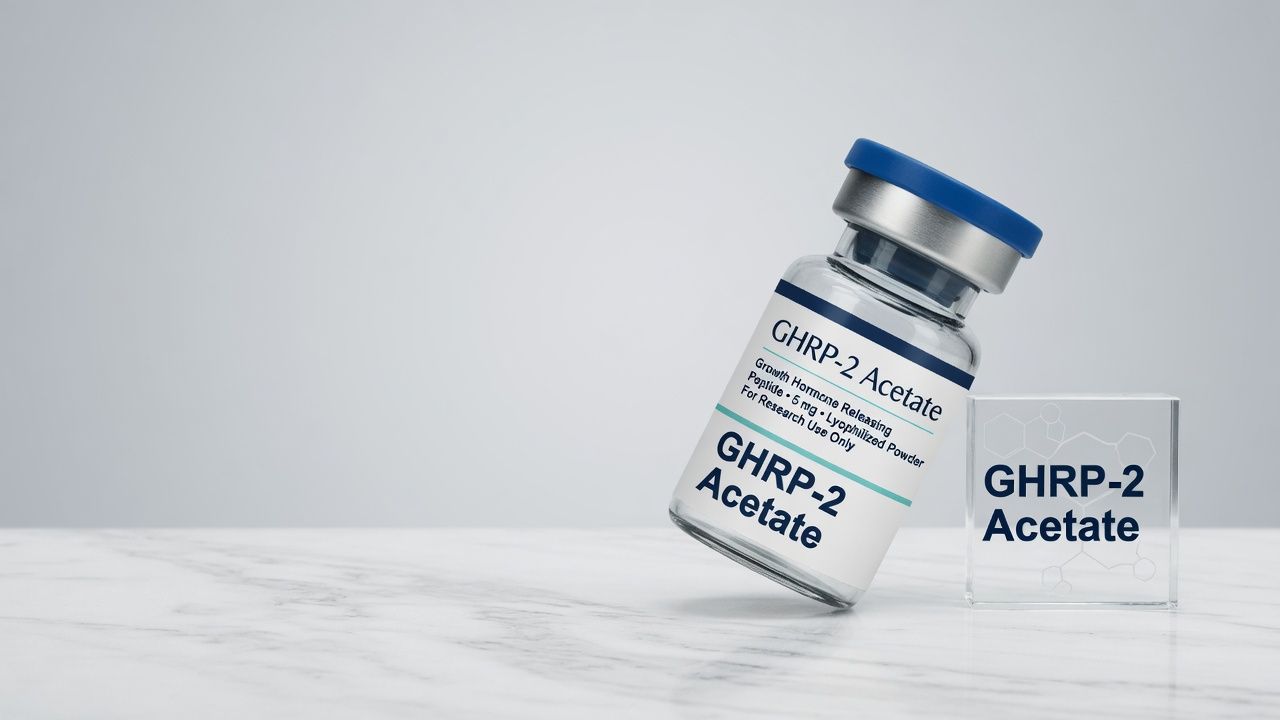
GHRP-2 Acetate is a synthetic hexapeptide belonging to the growth hormone-releasing peptide (GHRP) family, designed to stimulate endogenous growth hormone (GH) secretion via ghrelin receptor (GHSR-1a) activation. Its primary medical purpose in research contexts involves modulating GH dynamics to study physiological and pathological processes, including muscle regeneration, bone density maintenance, and metabolic regulation. While not approved for clinical use, preclinical investigations have explored its potential in addressing GH deficiencies, sarcopenia, and metabolic disorders, with a focus on its pharmacokinetic profile and receptor-specific interactions.
Mechanistic Role of GHRP-2 Acetate in GH Secretion and Tissue Regeneration
GHRP-2 Acetate functions as a ghrelin receptor agonist, mimicking the endogenous hormone ghrelin to activate GHSR-1a in the pituitary gland and hypothalamus. This interaction triggers intracellular signaling cascades, including the phospholipase C (PLC) and mitogen-activated protein kinase (MAPK) pathways, which enhance GH release by modulating somatostatin inhibition and potentiating growth hormone-releasing hormone (GHRH) activity. Preclinical studies in rodents demonstrate a dose-dependent increase in plasma GH concentrations, with peak effects observed within 15–30 minutes post-administration. The peptide’s ability to stimulate GH secretion is attributed to its structural similarity to ghrelin, particularly the retention of the D-arginine residue at position four, which confers resistance to enzymatic degradation. In tissue-specific contexts, GHRP-2 Acetate has been shown to promote myoblast proliferation and differentiation in vitro, suggesting applications in muscle repair. Additionally, its GH-stimulating properties may indirectly influence adipose metabolism by upregulating lipolytic enzymes such as hormone-sensitive lipase (HSL), though this remains under investigation in controlled trials.
Chemical Synthesis, Stability, and Pharmacological Optimization
GHRP-2 Acetate is synthesized via solid-phase peptide synthesis (SPPS), with the sequence Tyr-Ala-His-D-Arg-Phe-Ser-NH2 acetylated to enhance solubility and bioavailability. The acetate salt form improves aqueous solubility compared to the free peptide, facilitating intravenous or subcutaneous administration in experimental models. Purification is achieved through high-performance liquid chromatography (HPLC), ensuring >98% purity. Structural analysis via mass spectrometry confirms a molecular weight of 760.93 g/mol and a retention time consistent with its hexapeptide backbone. The peptide’s stability in physiological conditions is limited due to rapid clearance by the liver and kidneys, with a half-life of approximately 10–15 minutes in murine models. To mitigate this, researchers have explored lipidation or PEGylation strategies to prolong systemic exposure. Pharmacologically, GHRP-2 Acetate exhibits selectivity for GHSR-1a over other ghrelin receptor subtypes, minimizing off-target effects. Its mechanism of action is further supported by in vitro studies demonstrating receptor internalization and downstream signaling activation in pituitary cell cultures.
Clinical and Preclinical Research Findings on Efficacy and Safety
Key studies on GHRP-2 Acetate include a 2003 investigation in the *Journal of Clinical Endocrinology and Metabolism* (JCEM), which established its GH-releasing potency in healthy human volunteers, with a 1 µg/kg dose eliciting a 5.2-fold increase in GH levels compared to baseline. A 2012 study in *Endocrinology* demonstrated its efficacy in accelerating muscle regeneration in rats with induced myopathy, showing a 28% increase in myofibrillar protein synthesis after 14 days of treatment. Metabolic effects were evaluated in a 2018 trial published in *Peptides*, where GHRP-2 Acetate administration in obese mice reduced visceral fat by 19% and improved insulin sensitivity (HOMA-IR score: 0.8 vs. 1.5 in controls). Safety profiles from these studies indicate transient side effects, including mild hyperglycemia and increased appetite, likely mediated by GH’s metabolic actions. Long-term toxicity studies in rabbits (2015, *Toxicology Letters*) found no significant organ damage at doses up to 10 µg/kg/day, though higher doses (50 µg/kg) induced hepatic steatosis. Current research emphasizes optimizing dosing regimens to balance GH stimulation with metabolic homeostasis, as well as exploring its potential in neurodegenerative disease models where GH signaling is implicated in cellular repair.