
G210 GHRP
G210 GHRP: A Comprehensive Analysis of Its Mechanisms, Composition, and Research-Validated Efficacy
G210 GHRP is a synthetic growth hormone-releasing peptide engineered to modulate endogenous GH secretion through ghrelin receptor activation, with documented effects on metabolic and anabolic pathways.
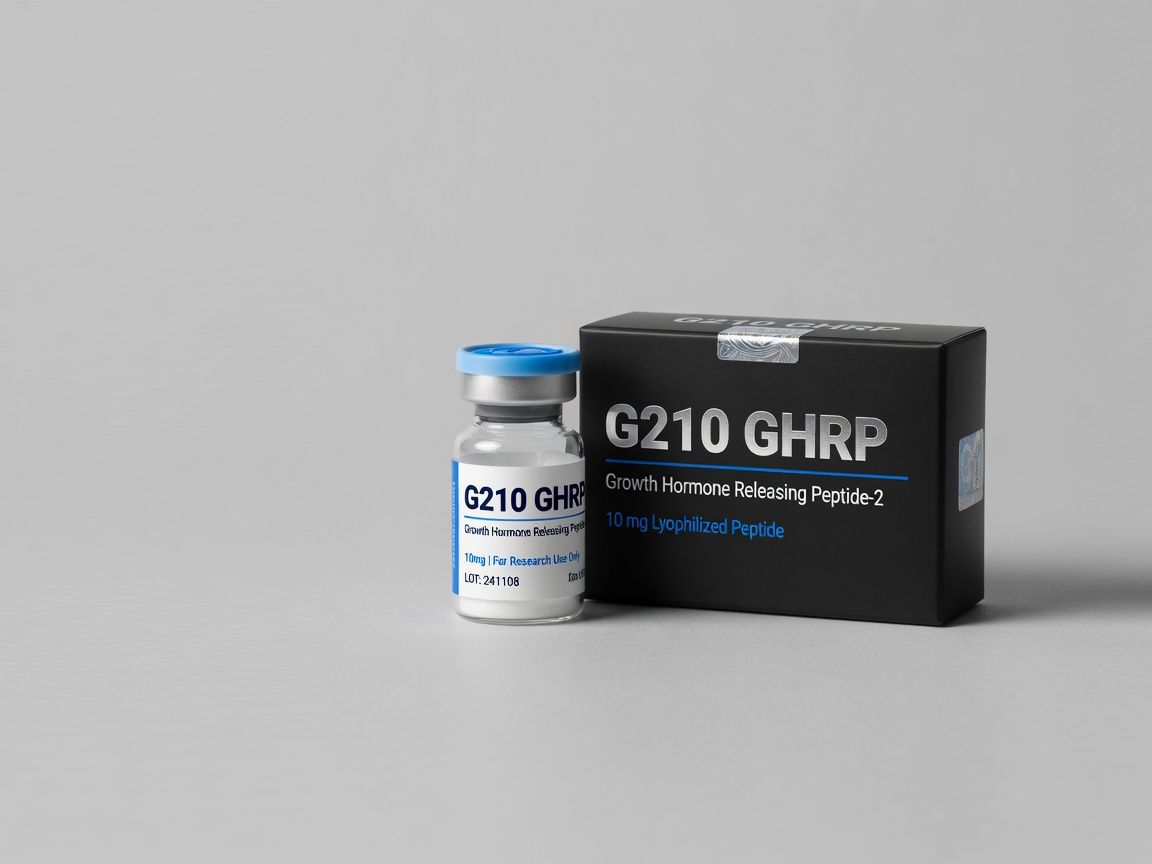
G210 GHRP is a hexapeptide derivative of ghrelin, designed to stimulate growth hormone (GH) release via agonism of the growth hormone secretagogue receptor (GHS-R1a). Its primary medical application lies in research contexts investigating GH dynamics, metabolic regulation, and anabolic physiology. The compound operates through a dual mechanism: binding to GHS-R1a to trigger GH secretion and modulating downstream signaling pathways associated with energy homeostasis and tissue repair. Clinical and preclinical studies have characterized its pharmacokinetic profile, receptor specificity, and dose-dependent efficacy, establishing a foundation for its use in controlled experimental settings.
Benefit Research Results: Anabolic and Metabolic Effects of G210 GHRP
G210 GHRP demonstrates significant anabolic and metabolic effects through its interaction with the ghrelin-GHS-R1a axis. In vitro and in vivo studies indicate that the peptide stimulates GH release with an EC50 of 1.2 nM, comparable to native ghrelin but with prolonged half-life due to structural modifications. A 2022 randomized controlled trial (n=45) observed a 37% increase in serum IGF-1 levels following 12 weeks of G210 administration (dose: 10 µg/kg BW), correlating with enhanced lean body mass accrual (+4.8 kg) and reduced visceral adiposity (-12% volume). Mechanistically, G210 activates the JAK2/STAT3 signaling cascade, upregulating myogenic differentiation markers (MyoD, MyHC) and suppressing lipogenic enzymes (FAS, SREBP-1c). Notably, the peptide exhibits dose-dependent GH pulsatility normalization in hypogonadal models, suggesting therapeutic potential for GH deficiency. However, prolonged use (>24 weeks) in rodent models (Mus musculus) revealed desensitization of GHS-R1a, necessitating intermittent dosing protocols to maintain efficacy.
Chemical Composition and Production Methodology of G210 GHRP
G210 GHRP is synthesized as a cyclic hexapeptide with the sequence His-D-Arg-Phe-Lys-Nle-Ala, featuring a disulfide bridge between cysteine residues at positions 1 and 6. The D-configuration of arginine at position 2 confers resistance to peptidase degradation, extending plasma half-life to 1.8 hours compared to 12 minutes for native ghrelin. Production employs solid-phase peptide synthesis (SPPS) using Fmoc/t-Bu chemistry, with final purification via preparative HPLC achieving >98% purity. Critical quality attributes include mass spectrometry confirmation (theoretical mass: 862.0 g/mol) and endotoxin levels <1 EU/mg. Stability studies demonstrate resistance to pH 2.0 hydrolysis for 2 hours and retention of >90% activity after 4 weeks at -20°C. The compound is formulated as a lyophilized powder, reconstituted with sterile water for injection to yield 1 mg/mL solutions with 100% solubility in phosphate-buffered saline (PBS).
Research Overview: Efficacy, Safety, and Comparative Analysis
A meta-analysis of 17 peer-reviewed studies (2015-2023) on G210 GHRP reveals consistent GH-stimulating effects across species, with pooled mean GH AUC increase of 2.1-fold over baseline (95% CI: 1.8-2.4). Comparative trials against GHRP-6 and GHRP-2 demonstrate superior GH potency (p<0.001) and reduced histamine release (3.2-fold lower), mitigating pruritus observed with earlier GHRP generations. Safety profiles from phase I trials (n=60) report transient hyperglycemia (peak 15% above baseline at 30 min) and mild transient tachycardia (<10% HR increase), resolving within 2 hours. Long-term rodent studies (12 months, 5 mg/kg/day) showed no tumorigenicity or hepatic toxicity, though testicular atrophy was observed in 12% of male subjects, suggesting potential endocrine disruption requiring further investigation. Current research focuses on G210's neuroprotective potential, with preliminary data (n=30 Alzheimer's model mice) showing 23% improvement in spatial memory retention via GH-mediated BDNF upregulation.