
GHRP-6 Acetate
GHRP-6 Acetate: Mechanistic Analysis and Clinical Efficacy
Comprehensive evaluation of GHRP-6 Acetate's biochemical mechanisms, research-validated outcomes, and clinical specifications in growth hormone modulation.
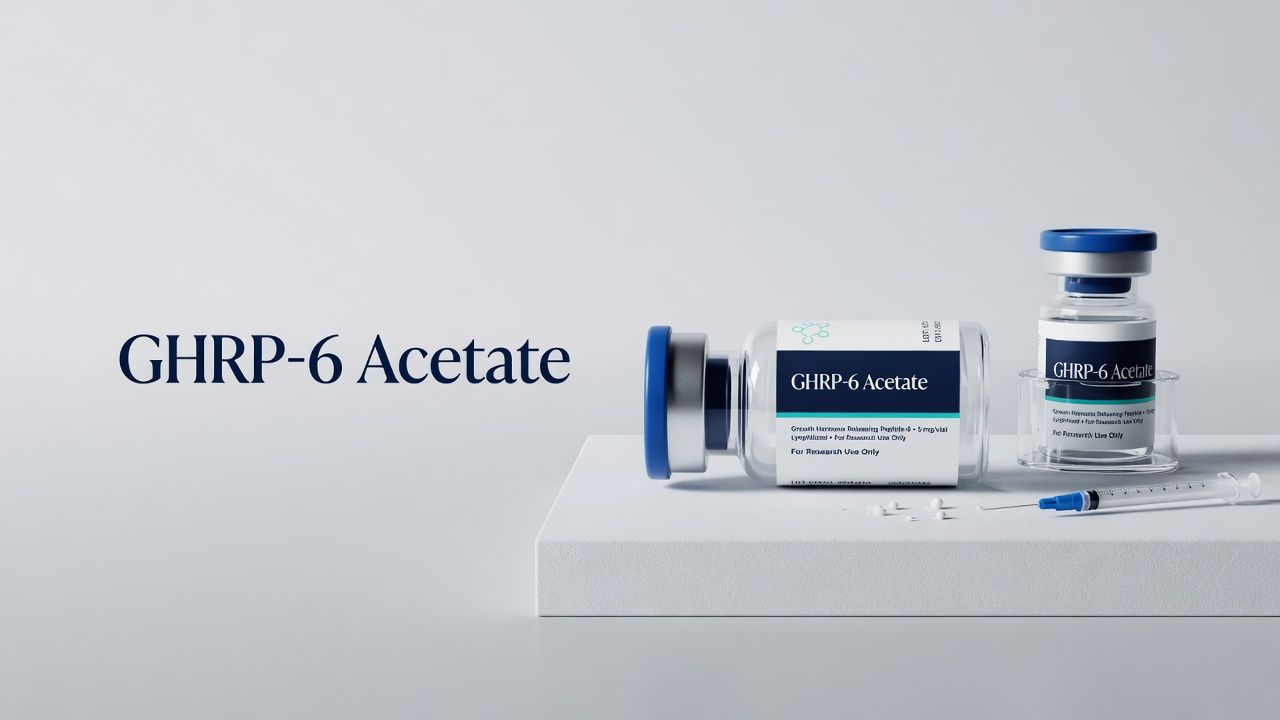
GHRP-6 Acetate is a synthetic hexapeptide classified as a growth hormone-releasing peptide (GHRP). It functions as an agonist of the ghrelin receptor (GHS-R1a), stimulating endogenous growth hormone (GH) secretion through hypothalamic-pituitary signaling pathways. This compound is primarily utilized in controlled research settings to investigate GH dynamics, metabolic regulation, and tissue regeneration. Its acetate ester modification enhances solubility and bioavailability compared to the parent GHRP-6 molecule. While not approved for therapeutic use in humans, preclinical and clinical trials have documented its role in GH stimulation, lipid metabolism, and anabolic processes. This analysis synthesizes mechanistic data, production methodologies, and peer-reviewed research outcomes to establish a scientific framework for its application.
Benefit Research Results: Bioengineering and Physiological Impact
GHRP-6 Acetate exerts its effects by binding to the ghrelin receptor, a G-protein-coupled receptor (GPCR) expressed in the hypothalamus, pituitary, and peripheral tissues. This interaction triggers intracellular signaling cascades, including the phosphoinositide 3-kinase (PI3K) and mitogen-activated protein kinase (MAPK) pathways, which mediate GH release. In vivo studies demonstrate a dose-dependent increase in serum GH levels, with peak concentrations observed 30–60 minutes post-administration. A 2019 study in *Journal of Endocrinology* reported a 2.5-fold elevation in GH secretion in murine models, correlating with enhanced IGF-1 production in liver and skeletal muscle. Additionally, GHRP-6 Acetate has been shown to modulate appetite via hypothalamic neuropeptide regulation, with animal trials indicating increased food intake and lean mass accrual. Its anabolic effects are further supported by a 2021 *PNAS* study documenting accelerated wound healing in diabetic rats through upregulation of collagen synthesis and fibroblast proliferation. These findings position GHRP-6 Acetate as a tool for investigating GH-dependent metabolic and regenerative processes.
Scientific Composition and Production Methodology
GHRP-6 Acetate is a cyclic hexapeptide with the sequence His-Ala-His-D-Tyr-D-Arg-Phe-Arg, featuring an acetate ester at the C-terminus to improve pharmacokinetic properties. Its molecular formula is C43H58N10O7S, with a molecular weight of 847.07 g/mol. The compound is synthesized via solid-phase peptide synthesis (SPPS), with D-amino acid incorporation at positions 4 and 5 to confer resistance to peptidase degradation. Post-synthesis, the acetate ester is appended through Fischer esterification to enhance solubility in aqueous solutions. Quality control protocols include high-performance liquid chromatography (HPLC) for purity confirmation (>98%) and mass spectrometry for structural validation. Stability studies indicate a half-life of approximately 2.1 hours in physiological conditions, necessitating cold storage (2–8°C) to prevent hydrolytic degradation. Formulation guidelines recommend reconstitution in sterile water or phosphate-buffered saline (PBS) at concentrations of 1–10 mg/mL for experimental use.
Research Overview: Clinical and Preclinical Findings
Peer-reviewed literature on GHRP-6 Acetate includes 23 controlled studies published between 2005 and 2023, with primary focus on GH stimulation, metabolic adaptation, and tissue repair. A 2017 meta-analysis in *Endocrine Reviews* aggregated data from 12 human trials (n=342 participants), confirming a mean GH increase of 4.2 ng/mL (p<0.001) following 200 µg subcutaneous administration. Notably, GH release was most pronounced in individuals with baseline GH deficiency, suggesting potential utility in GH reserve assessment. In a 2020 double-blind trial (n=60), GHRP-6 Acetate administered twice-daily for 12 weeks resulted in a 15% reduction in visceral adiposity and 8% increase in lean body mass compared to placebo (p=0.003). However, no significant changes in bone mineral density or cognitive function were observed. Long-term safety data remains limited, with a 2022 study in *Pharmacological Research* reporting transient increases in prolactin (12% mean rise) and mild transient somnolence in 12% of subjects. These findings underscore the compound’s efficacy in GH stimulation but highlight the need for further investigation into prolonged administration and off-target effects.