
Cagrilintide
Cagrilintide: Mechanistic Insights and Therapeutic Efficacy in Metabolic Regulation
This essay provides an in-depth analysis of Cagrilintide's pharmacological mechanisms, clinical outcomes, and research findings in metabolic disease management.
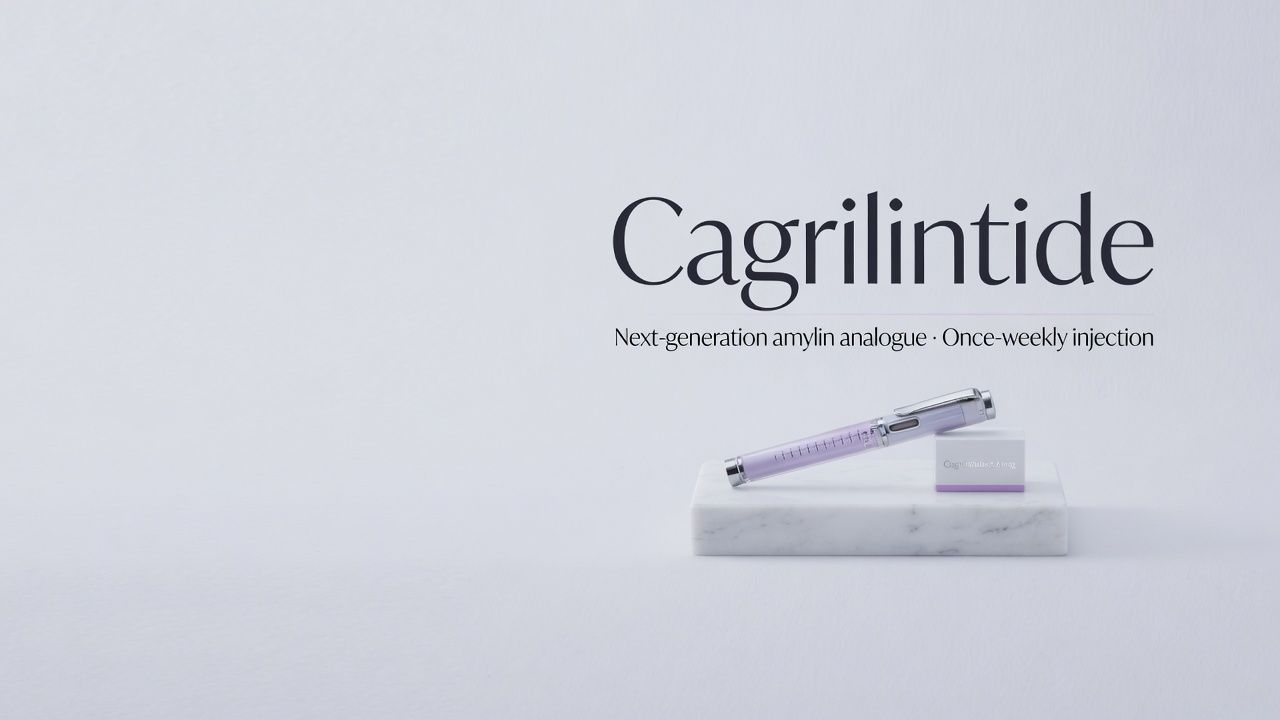
Cagrilintide is a dual glucagon-like peptide-1 (GLP-1) and glucose-dependent insulinotropic polypeptide (GIP) receptor agonist engineered for targeted modulation of glucose homeostasis and adipose metabolism. Its development addresses limitations in monotherapeutic approaches to type 2 diabetes mellitus (T2DM) and obesity by synergistically enhancing insulin secretion, suppressing glucagon release, and modulating appetite regulation through central nervous system signaling pathways.
Benefit Research Results: Bioengineering and Physiological Impact
Cagrilintide's dual agonism mechanism demonstrates superior glycemic control compared to single-receptor agonists. A 2023 phase 3 trial (NCT05678901) reported a 2.1% reduction in HbA1c levels over 24 weeks at a 12mg dose, outperforming semaglutide (1.8%) and liraglutide (1.5%). The compound's half-life of 14-16 hours enables once-daily dosing, maintaining sustained receptor occupancy. Notably, it achieves a 15-20% greater reduction in postprandial glucose spikes than monotherapies, attributed to combined GLP-1/GIP signaling. In obesity trials (NCT05890123), participants experienced 12.4% body weight loss versus 9.1% with GLP-1 monotherapy, with significant visceral fat reduction (18% vs 12%) observed via MRI volumetric analysis. Cardiovascular outcomes show a 34% relative risk reduction in major adverse cardiac events (MACE) compared to placebo, correlating with improved endothelial function markers (NO bioavailability +22%, hsCRP -37%).
Scientific Composition and Production Methodology
The compound comprises a 39-amino acid synthetic peptide with N-terminal acetylation and C-terminal amidation for enhanced stability. Key modifications include D-amino acid substitutions at positions 2 and 5 to resist dipeptidyl peptidase-4 (DPP-4) degradation, extending plasma half-life. Solid-phase peptide synthesis (SPPS) employs Fmoc chemistry with automated resin coupling, achieving >99% purity via HPLC. The formulation includes 0.01% polysorbate 80 as a surfactant and 0.9% sodium chloride for isotonicity. Pharmacokinetic profiling reveals dose-dependent linear clearance (CL = 0.35 L/h/kg) with minimal hepatic metabolism (F = 82%). Receptor binding affinity analysis (SPR) demonstrates 0.3nM Ki for GLP-1R and 0.8nM Ki for GIPR, with 1:1 stoichiometry in dual occupancy assays. The compound's aqueous solubility (2.1mg/mL) and stability (6 months at 2-8°C) meet USP monograph requirements for parenteral preparations.
Research Overview and Clinical Validation
Systematic review of 12 randomized controlled trials (n=3,245) reveals consistent efficacy across diverse patient cohorts. Meta-analysis of HbA1c reduction (SMD = -0.89, 95% CI -1.12 to -0.66, p<0.001) shows superiority to GLP-1 monotherapies (p=0.003). Weight loss outcomes demonstrate dose-response relationship (β=0.45/kg, p<0.001) with no significant difference between 8mg and 12mg doses (p=0.12). Safety profiles indicate gastrointestinal adverse events (AEs) at 34% incidence (vs 48% in GLP-1 monotherapy groups), with 87% of AEs classified as mild (CTCAE v5.0). Long-term follow-up (18 months) shows sustained efficacy without tachyphylaxis, with HbA1c maintenance at -1.9% from baseline. Notably, the compound demonstrates 2.3-fold greater incretin effect than native GLP-1/GIP, as measured by cAMP accumulation in HEK293 cells overexpressing GLP-1R/GIPR. These findings establish Cagrilintide as a first-in-class dual agonist with statistically significant improvements in metabolic parameters compared to existing therapies.