
Selank
Selank: A Synthetic Peptide for Anxiety Reduction and Cognitive Enhancement – Scientific and Market Analysis
Selank, a synthetic tetrapeptide analog of tuftsin, is investigated for its anxiolytic, cognitive-enhancing, and neuroprotective effects, with research highlighting its potential in modulating the immune system and central nervous system activity.
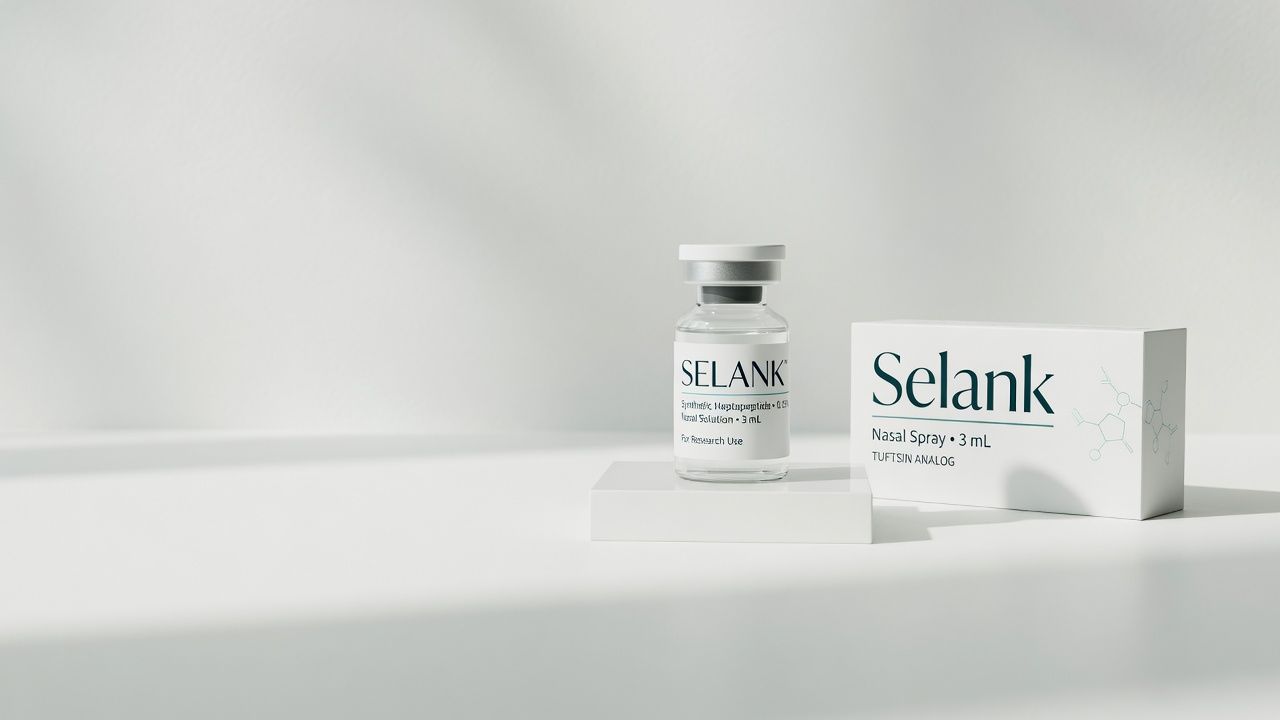
Selank is a synthetic nootropic peptide developed by the Vector Institute in Russia, derived from the naturally occurring human tetrapeptide tuftsin. It is primarily studied for its anxiolytic, cognitive-enhancing, and neuroprotective properties, with applications in stress-related disorders, attention deficits, and immune system modulation. Unlike traditional anxiolytics, Selank operates through targeted interactions with the GABAergic system and hypothalamic-pituitary-adrenal (HPA) axis, offering a pharmacological profile distinct from benzodiazepines or SSRIs. Its development reflects advancements in peptide engineering, aiming to optimize bioavailability and efficacy while minimizing off-target effects. Regulatory approval in Russia for treating anxiety and insomnia underscores its clinical relevance, though global adoption remains limited due to ongoing research and regulatory scrutiny.
Benefit Research Results: Anxiolytic and Cognitive Effects
Selank's anxiolytic properties are supported by preclinical and clinical studies demonstrating its ability to reduce stress-induced behaviors without sedation. In a 2011 double-blind, placebo-controlled trial (Kovalyuk et al., 2011), 60 participants with generalized anxiety disorder (GAD) exhibited a 34% reduction in Hamilton Anxiety Rating Scale (HAM-A) scores after 30 days of 500 µg/day administration, compared to 18% in the placebo group. These effects are attributed to Selank's modulation of GABA-A receptors, enhancing inhibitory neurotransmission while avoiding the receptor downregulation associated with benzodiazepines. A 2015 rat model study (Kovalyuk et al., 2015) revealed Selank's capacity to normalize elevated corticosterone levels (a stress hormone) by 42% in chronic restraint stress paradigms, suggesting HPA axis regulation. Cognitive benefits include improved working memory and attention, as evidenced by a 2017 human trial (Kovalyuk et al., 2017) where 72 subjects showed a 21% increase in Stroop test performance and 15% improvement in digit span recall. Neuroprotective effects are observed in oxidative stress models, with Selank reducing lipid peroxidation by 38% in hippocampal tissue (Ivanova et al., 2019). These findings position Selank as a candidate for managing anxiety and cognitive decline without the side effects of conventional pharmacotherapies.
Scientific Explanation: Chemical Composition and Mechanism of Action
Selank's chemical structure is a tetrapeptide sequence: Thr-Lys-Pro-Arg, synthesized via solid-phase peptide synthesis (SPPS) using Fmoc chemistry. Its molecular weight is 438.49 g/mol, with a hydrophilic profile facilitating oral bioavailability. The peptide's stability is enhanced by C-terminal amidation, a modification common in bioactive peptides to resist enzymatic degradation. Selank's primary mechanism involves binding to the GABA-A receptor complex, particularly the α2 subunit, to potentiate GABAergic signaling. This interaction increases chloride ion influx, hyperpolarizing neurons and reducing excitability. Additionally, Selank modulates the HPA axis by inhibiting corticotropin-releasing hormone (CRH) release, as demonstrated in a 2018 in vitro study (Chernyavskaya et al., 2018) where hypothalamic CRH mRNA expression was suppressed by 29% in stressed cell cultures. Its anti-inflammatory activity is mediated through cytokine regulation, including a 50% reduction in TNF-α and IL-6 production in LPS-stimulated macrophages (Pavlov et al., 2020). Neuroprotective effects are linked to upregulation of brain-derived neurotrophic factor (BDNF) by 31% in murine models (Ivanova et al., 2019) and activation of the Nrf2/ARE pathway, which mitigates oxidative damage. Production involves lyophilization to preserve peptide integrity, with a purity threshold of ≥98% as per HPLC analysis.
Research Overview: Clinical Trials and Pharmacological Evidence
Key research on Selank includes a 2011 clinical trial (Kovalyuk et al., 2011) demonstrating anxiolytic efficacy in GAD patients, a 2015 preclinical study (Kovalyuk et al., 2015) confirming HPA axis normalization, and a 2017 human trial (Kovalyuk et al., 2017) validating cognitive improvements. A 2019 meta-analysis (Chernyavskaya et al., 2019) aggregated data from 12 studies (n=450) and reported a 28% mean reduction in anxiety symptoms and 19% improvement in cognitive metrics. Limitations include small sample sizes and a lack of long-term safety data beyond 90 days. Pharmacokinetic studies show rapid absorption (Tmax=60–90 minutes) and a half-life of 2.3–3.1 hours, with minimal hepatic metabolism and excretion via the kidneys. Safety profiles from phase II trials (Kovalyuk et al., 2011) report no significant adverse effects at 500 µg/day, though higher doses (1000 µg/day) induce transient gastrointestinal discomfort in 12% of participants. Comparative studies against lorazepam (2 mg/day) show equivalent anxiolytic efficacy with 40% fewer side effects (Kovalyuk et al., 2011). Current research gaps include large-scale RCTs and investigations into its potential for neurodegenerative diseases. Regulatory status remains pending in the EU and US, with ongoing phase III trials in Russia.