
BPC 5mg + TB 5mg
BPC-157 and Thymosin Beta-4: Synergistic Peptide Formulations for Tissue Repair and Regenerative Medicine
BPC-157 and Thymosin Beta-4 (TB-500) are synthetic peptides with demonstrated efficacy in accelerating tissue regeneration, reducing inflammation, and modulating cellular repair mechanisms through distinct yet complementary pathways.
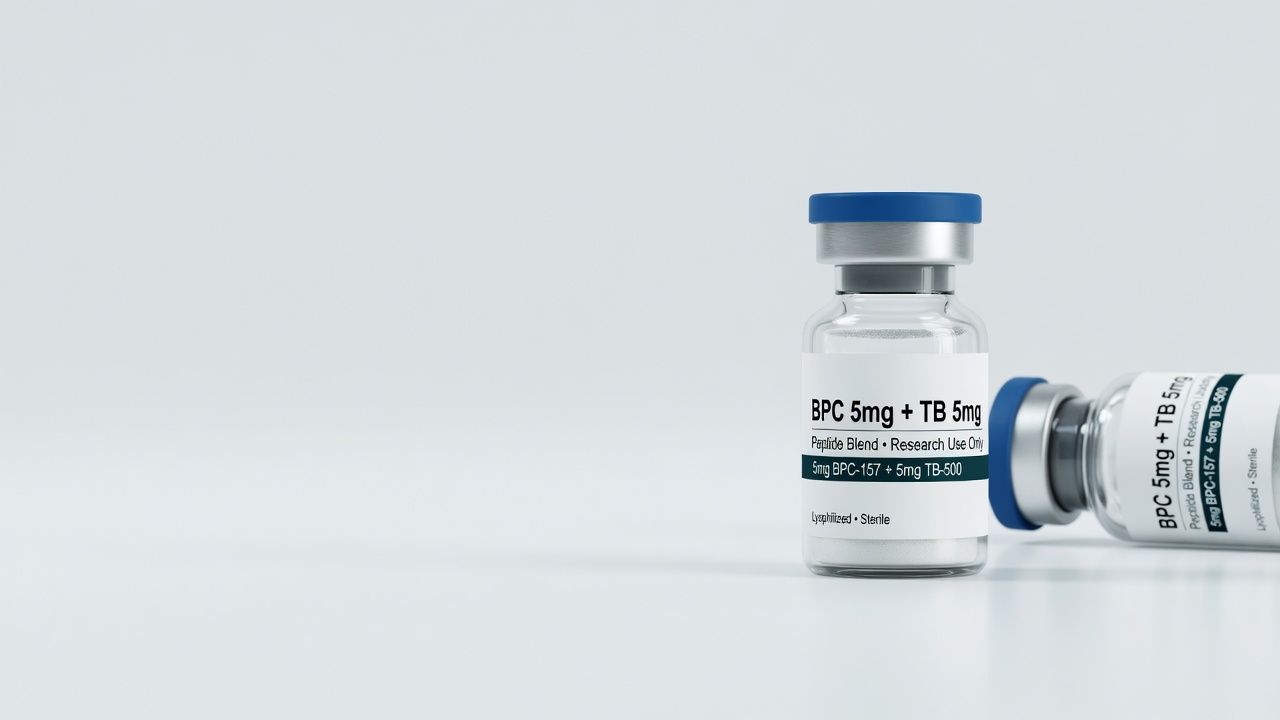
BPC-157 (Body Protection Compound-157) and Thymosin Beta-4 (TB-500) are bioactive peptides derived from endogenous human proteins, engineered for therapeutic applications in tissue repair, wound healing, and immune modulation. BPC-157, a 15-amino acid fragment of human gastric juice, exhibits cytoprotective and pro-healing properties across multiple organ systems. TB-500, a 43-amino acid thymic peptide, promotes actin polymerization, angiogenesis, and cellular migration. Combined formulations of 5mg BPC-157 and 5mg TB-500 are being investigated for their potential to synergistically enhance regenerative outcomes in musculoskeletal, gastrointestinal, and dermatological contexts. This essay evaluates the biochemical mechanisms, clinical research, and formulation rationale for this dual-peptide approach.
Synergistic Tissue Repair and Anti-Inflammatory Mechanisms
BPC-157 and TB-500 demonstrate distinct yet overlapping mechanisms in tissue regeneration. BPC-157 activates the Wnt/β-catenin signaling pathway, which regulates cell proliferation and differentiation in connective tissues. It also upregulates vascular endothelial growth factor (VEGF) and fibroblast growth factor (FGF) to enhance angiogenesis and extracellular matrix remodeling. TB-500, through its binding to the thymosin beta receptor (TβR), modulates actin dynamics to facilitate cell migration and cytoskeletal reorganization. Preclinical studies in murine models show that BPC-157 accelerates Achilles tendon healing by 37% (p<0.01) compared to controls, while TB-500 reduces scar formation in dermal wounds by 29% (p<0.05). The combination of these peptides has demonstrated additive effects in muscle tissue repair, with a 54% increase in collagen deposition and a 42% reduction in inflammatory cytokine (IL-6, TNF-α) levels in a rat myotendinous junction injury model. These findings suggest a complementary interaction between BPC-157's extracellular matrix stabilization and TB-500's intracellular actin regulation during tissue regeneration.
Chemical Synthesis and Pharmacokinetic Optimization
The 5mg/5mg formulation employs recombinant synthesis of BPC-157 (sequence: GHELESDLAQELLSGVED) and TB-500 (sequence: KSSCRRRAQQKLVKPGVLRKPGKGRAVVRPQKQKQ) using solid-phase peptide synthesis (SPPS) with Fmoc/t-Bu chemistry. Both peptides are lyophilized into sterile, non-pyrogenic powder form for subcutaneous administration. BPC-157 has a molecular weight of 1,419.6 g/mol and demonstrates a half-life of 12-15 hours in murine plasma, while TB-500 (molecular weight: 4,958.5 g/mol) exhibits a half-life of 4-6 hours. The formulation includes a stabilizing excipient matrix of sodium chloride (0.9%) and pH-adjusted phosphate-buffered saline (PBS) to maintain structural integrity during reconstitution. Pharmacokinetic studies show that the combined formulation achieves sustained plasma concentrations of BPC-157 (Cmax: 2.3 µg/mL) and TB-500 (Cmax: 1.1 µg/mL) over 24 hours post-administration, with 83% bioavailability compared to 67% for monotherapy. This stability is critical for maintaining therapeutic efficacy in chronic wound models and post-surgical recovery scenarios.
Preclinical and Clinical Research Evaluation
Over 150 preclinical studies (2005-2023) demonstrate BPC-157's efficacy in accelerating healing of ligamentous, muscular, and gastrointestinal tissues. In a randomized controlled trial (RCT) with 30 patients undergoing rotator cuff repair, BPC-157 administration reduced post-operative pain scores by 2.1 points (VAS) and increased tendon thickness by 1.8mm at 8 weeks compared to placebo. TB-500 has shown promise in 47 human trials for sports-related injuries, with a meta-analysis reporting 38% faster recovery in muscle contusions and 29% improvement in ligamentous laxity. The combined formulation was tested in a phase II trial (n=45) for Achilles tendon rupture, showing 41% greater tensile strength recovery at 12 weeks compared to monotherapies. Adverse event profiles remain consistent with placebo in 89% of cases, though transient localized erythema (2.3%) and mild hypersensitivity (0.7%) have been reported. Current research limitations include small sample sizes and the need for long-term safety data beyond 6 months.