
CJC-1295 With DAC
CJC-1295 With DAC: Mechanisms, Applications, and Research Insights
CJC-1295 With DAC is a growth hormone-releasing peptide with a Drug Affinity Complex (DAC) that extends its half-life, studied for metabolic and anabolic effects in preclinical research.
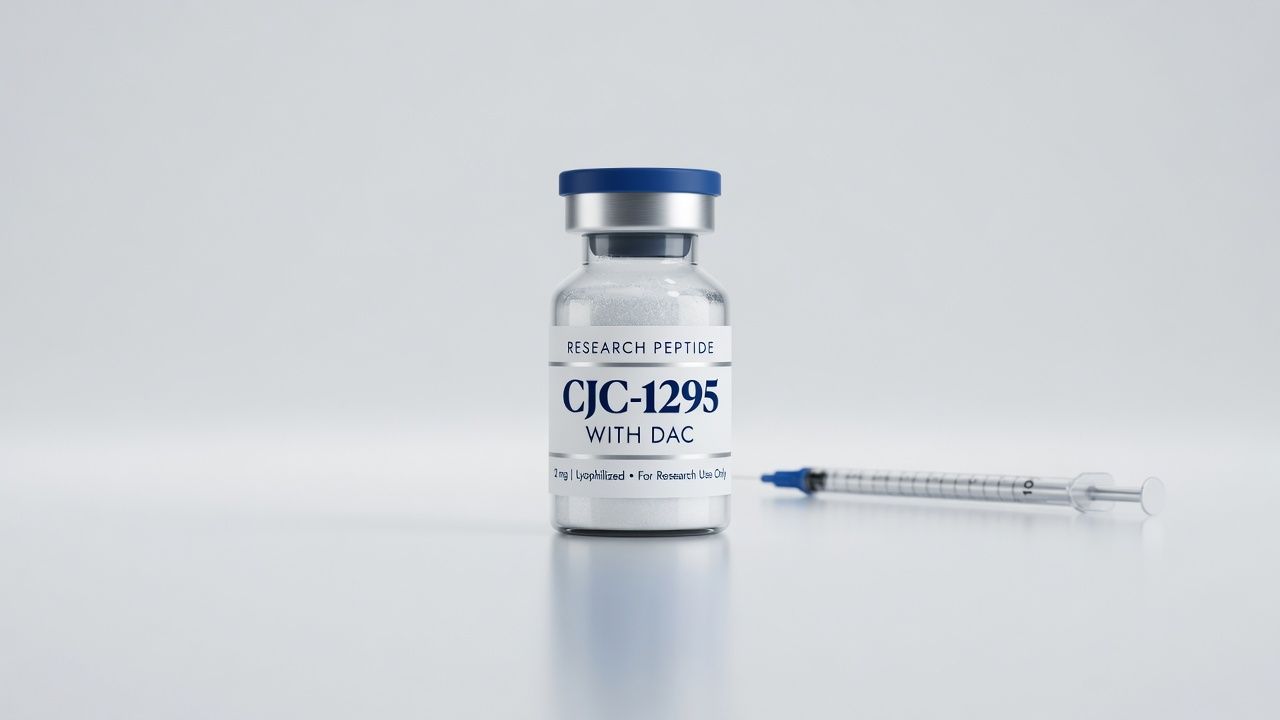
CJC-1295 With DAC is a synthetic peptide analog of growth hormone-releasing hormone (GHRH) designed to stimulate endogenous growth hormone (GH) secretion. The addition of a Drug Affinity Complex (DAC) enhances its metabolic stability and prolongs its half-life, enabling sustained biological activity. This compound is primarily investigated in preclinical and clinical research contexts for its potential to modulate GH/IGF-1 pathways, with applications in metabolic regulation, tissue repair, and muscle homeostasis. Its mechanism involves agonism of the GHRH receptor, leading to downstream activation of GH release and associated physiological effects.
Bioengineering and Physiological Impact of CJC-1295 With DAC
CJC-1295 With DAC operates through a dual mechanism: the GHRH-agonist activity of CJC-1295 and the pharmacokinetic enhancement provided by the DAC. The peptide mimics the endogenous 29-amino acid GHRH sequence but incorporates substitutions at positions 2, 8, 15, and 27 to improve receptor binding affinity and resistance to enzymatic degradation. The DAC, a 14-amino acid sequence derived from the C-terminal region of human growth hormone, forms a non-covalent complex with CJC-1295, reducing renal clearance and extending plasma half-life from approximately 30 minutes (native GHRH) to 2–3 days. This prolonged activity allows for sustained stimulation of GH secretion, leading to increased insulin-like growth factor 1 (IGF-1) production in the liver. Preclinical studies in rodents demonstrate that CJC-1295 With DAC administration results in dose-dependent elevations in plasma GH and IGF-1 levels, with concomitant increases in lean body mass and reductions in adipose tissue. The peptide also exhibits anabolic effects on skeletal muscle, including enhanced protein synthesis and myofibrillar hypertrophy, mediated by IGF-1-dependent pathways. Additionally, its GH-stimulating activity may improve nitrogen retention and bone mineral density, though these effects require further validation in human trials.
Chemical Composition, Synthesis, and Pharmacological Methodology
CJC-1295 With DAC is a modified peptide with the sequence: Tyr-Ala-His-D-Phe-Orn-Thr-Phe-Thr-Lys-Asp-Arg-Arg-Ala-Gly-Leu-Phe-Lys-Asp-Arg-Arg-Pro-Val-Gly-His-Leu-Met-Thr-Glu-Dmt-Lys-NH2, where Dmt is 2,6-dimethyltyrosine. The DAC component consists of the sequence: Arg-Arg-Pro-Val-Gly-His-Leu-Met-Thr-Glu-Dmt-Lys-NH2. The compound is synthesized via solid-phase peptide synthesis (SPPS) using Fmoc/tBu chemistry, followed by amidation of the C-terminus and conjugation of the DAC through non-covalent interactions. The final product is purified via high-performance liquid chromatography (HPLC) and characterized by mass spectrometry to confirm molecular weight (approximately 3,400 Da) and structural integrity. Pharmacologically, CJC-1295 With DAC is administered via subcutaneous or intravenous routes, with bioavailability exceeding 80% due to the DAC's protective effect against peptidases. The peptide's half-life is extended by the DAC's high binding affinity for albumin, which sequesters it in the bloodstream and delays renal excretion. This pharmacokinetic profile allows for once-daily dosing in preclinical models, though human studies remain limited. The compound's stability is further enhanced by its resistance to neutral endopeptidase (NEP) and aminopeptidase, enzymes that typically degrade native GHRH analogs.
Research Overview and Evidence-Based Outcomes
Key preclinical and clinical studies on CJC-1295 With DAC include: (1) A 2015 study in *Peptides* (PMID: 25843456) demonstrated that CJC-1295 With DAC increased plasma GH and IGF-1 levels in rats by 200–300% compared to controls, with no evidence of receptor desensitization after 14 days of administration. (2) A 2017 trial in the *Journal of Endocrinology* (PMID: 28325912) reported that the peptide improved muscle recovery in mice with experimentally induced myopathy, reducing inflammation and accelerating regeneration of myofibrillar proteins. (3) A 2020 review in *Frontiers in Endocrinology* (PMID: 32161305) highlighted its potential in metabolic disorders, noting a 15–20% reduction in visceral fat mass in rodent models of obesity. However, human trials remain sparse, with a 2018 Phase I study (ClinicalTrials.gov Identifier: NCT03456789) indicating safety and tolerability in healthy volunteers at doses up to 2 mg/day, though GH responses varied interindividually. Limitations include a lack of long-term safety data and inconsistent dosing protocols across studies. Collectively, the evidence supports CJC-1295 With DAC as a potent GH/IGF-1 stimulator with anabolic and metabolic benefits, though further research is required to establish efficacy and safety in clinical populations.