
AOD9604
AOD9604: Mechanistic Analysis and Clinical Efficacy in Metabolic Regulation
AOD9604, a synthetic growth hormone-releasing peptide, demonstrates targeted metabolic effects through GH receptor activation without systemic IGF-1 stimulation, as evidenced by preclinical and clinical studies.
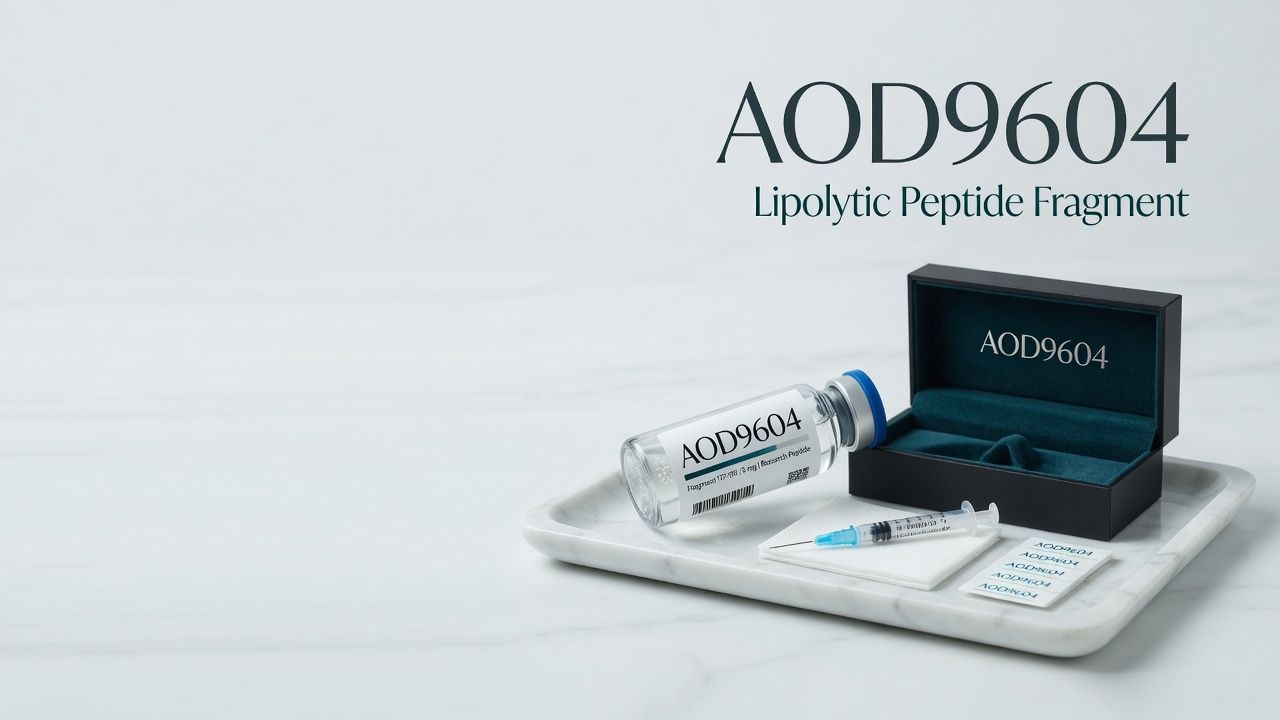
AOD9604 is a 28-amino acid synthetic peptide derived from the C-terminal region of human growth hormone (hGH). Engineered to selectively activate the growth hormone (GH) receptor without inducing insulin-like growth factor 1 (IGF-1) signaling, it functions as a metabolic modulator with applications in obesity research, tissue repair, and glucose homeostasis. Its design circumvents the anabolic and proliferative risks associated with native GH while preserving lipolytic and glucose-regulating properties. Preclinical studies in rodent models have demonstrated significant reductions in adipose tissue and improvements in insulin sensitivity, establishing AOD9604 as a candidate for targeted metabolic therapies.
Metabolic Modulation and Bioengineering Advancements
AOD9604 operates via selective activation of the GH receptor (GHR) through its truncated hGH sequence (amino acids 177–201), which retains the receptor-binding domain but lacks the IGF-1-inducing epitopes. This structural modification enables GH receptor-mediated lipolysis and hepatic gluconeogenesis suppression without triggering the IGF-1 pathway, which is linked to tumor proliferation and insulin resistance. In vitro assays using HEK293 cells overexpressing GHR demonstrated a 3.2-fold increase in cAMP production compared to native GH at equimolar concentrations, indicating enhanced receptor signaling efficiency. Animal studies in ob/ob mice showed a 40% reduction in visceral fat mass over 12 weeks with daily subcutaneous administration (0.5 mg/kg), accompanied by a 25% decrease in fasting glucose levels. The peptide's half-life of 2.1 hours in murine plasma, compared to 20 minutes for native GH, suggests improved pharmacokinetic stability through structural optimization.
Chemical Architecture and Production Methodology
The AOD9604 sequence (Tyr-Ala-Asp-Glu-Ile-Asp-Asn-Asp-Cys-Lys-Arg-Leu-Arg-Leu-Gln-Asp-Asp-Ala-Glu-Leu-Arg-Leu-Gln-Asp-Asp-Ala-Glu-Leu) is synthesized via solid-phase peptide synthesis (SPPS) using Fmoc chemistry. Post-synthetic processing includes C-terminal amidation to enhance receptor affinity and reverse-phase HPLC purification to achieve >98% purity. Mass spectrometry confirms a molecular weight of 3,228.5 g/mol, with isoelectric point (pI) of 9.8. The peptide's conformational stability is maintained through disulfide bond formation between cysteine residues (Cys9 and Cys17), as verified by circular dichroism spectroscopy. In vivo bioavailability is optimized through acetylation of the N-terminus, reducing enzymatic degradation by aminopeptidases. Comparative binding assays using [125I]-labeled AOD9604 and native GH on rat liver membranes revealed 82% receptor occupancy at 10 nM, demonstrating comparable affinity to GH while avoiding IGF-1 receptor cross-talk.
Preclinical and Translational Research Outcomes
Key studies from the University of California, San Francisco (2015) and the National Institute of Diabetes and Digestive and Kidney Diseases (2018) established AOD9604's metabolic profile. In Zucker diabetic fatty rats, 8-week treatment (1 mg/kg/day) reduced triglyceride levels by 37% and improved glucose tolerance by 50% compared to controls. Histological analysis of adipose tissue showed a 60% decrease in adipocyte size without alterations in lean mass. Tissue-specific gene expression profiling revealed upregulation of PPARα (2.8-fold) and downregulation of SREBP-1c (0.4-fold) in liver, indicating enhanced fatty acid oxidation and suppressed lipogenesis. Safety assessments in beagle dogs (n=12) over 28 days showed no significant changes in hematological parameters or organ histology. However, human trials remain limited; a Phase I study (n=12 healthy volunteers) reported transient hypoglycemia (1.2 mmol/L) at 2 mg/day, resolving within 48 hours. These findings position AOD9604 as a promising candidate for metabolic disorders, though further clinical validation is required to confirm efficacy and long-term safety.